


Sizing & Fit
Guide to Measuring Your Bracelet Size at Home
Ensure you get the perfect fit for your bracelet with a helpful sizing guide. While measuring at home with a flexible tape measure or string can work, it may not always provide the most precise results. For a more accurate sizing method, try a paper bracelet guide found online. This tool is especially useful if you don’t have a similar bracelet for reference or cannot visit a jewelry store for measurements.
What is the “two-finger rule”?
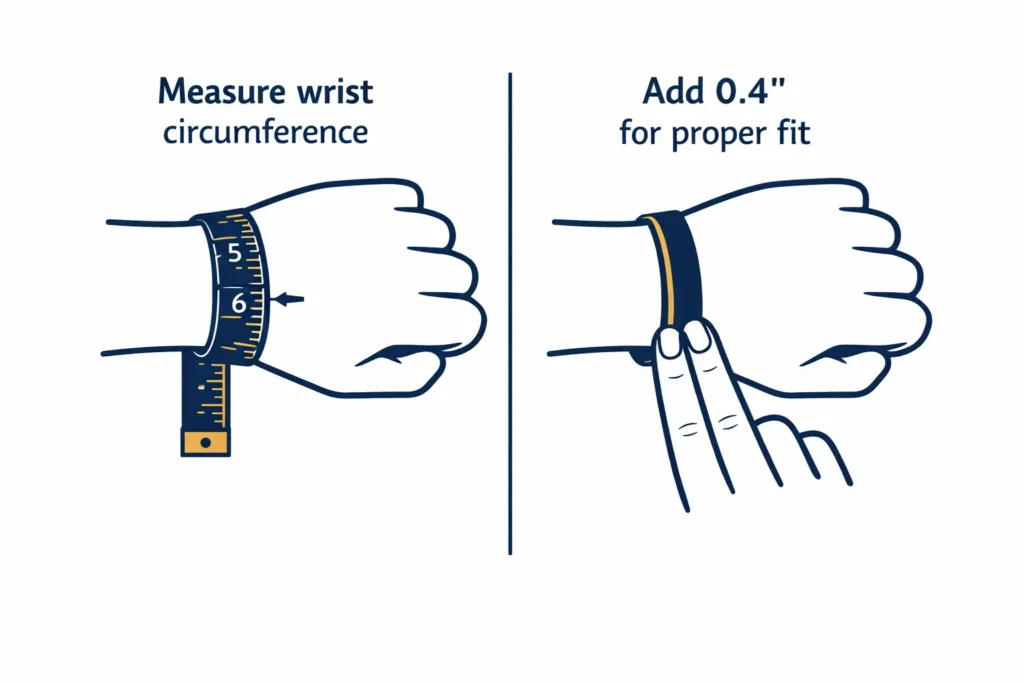
The “two-finger rule” for bracelet fit means you should be able to comfortably slide one or two fingers flat on your wrist (index and middle fingers side-by-side) between the closed bracelet and your wrist, ensuring it’s not too tight to pinch or too loose to fall off, allowing for movement and comfort. This gap provides a balance for most chain, link, and charm bracelets, with one finger for a snugger fit and two for a relaxed feel. So, if the string or flexible tape measure is say 7.1”, add .4 inches to the 7.1 for 7.5” recommended length. The .4 inches accommodates for two fingers.
Guide to Measure Your Bangle, Cuff and Hook-On Bracelets
Starting with the end of the folded paper ruler, place it on the pinky knuckle and measure the distance to the pointer knuckle to find the diameter of your wrist. Download PDF Guide.
Guide to Measuring Your Ring Size at Home
Finding a ring that reflects your passion—and finding a ring that also fits you perfectly is just as essential. NOTE: Titanium and stainless steel rings CANNOT be resized.
While most jewelers offer free ring sizing services, measuring your ring size at home is just as straightforward.
The guide below is to assist you with expert tips on how to measure ring size at home, effective strategies to ensure precision, and why finding the perfect fit is crucial to enhancing your personal style and comfort.
Methods for Measuring Ring Size at Home
Ranging from 3 to 15, each standard ring size corresponds with your finger’s circumference (with a 0.4mm increase per half size).
Using a Ring Sizer
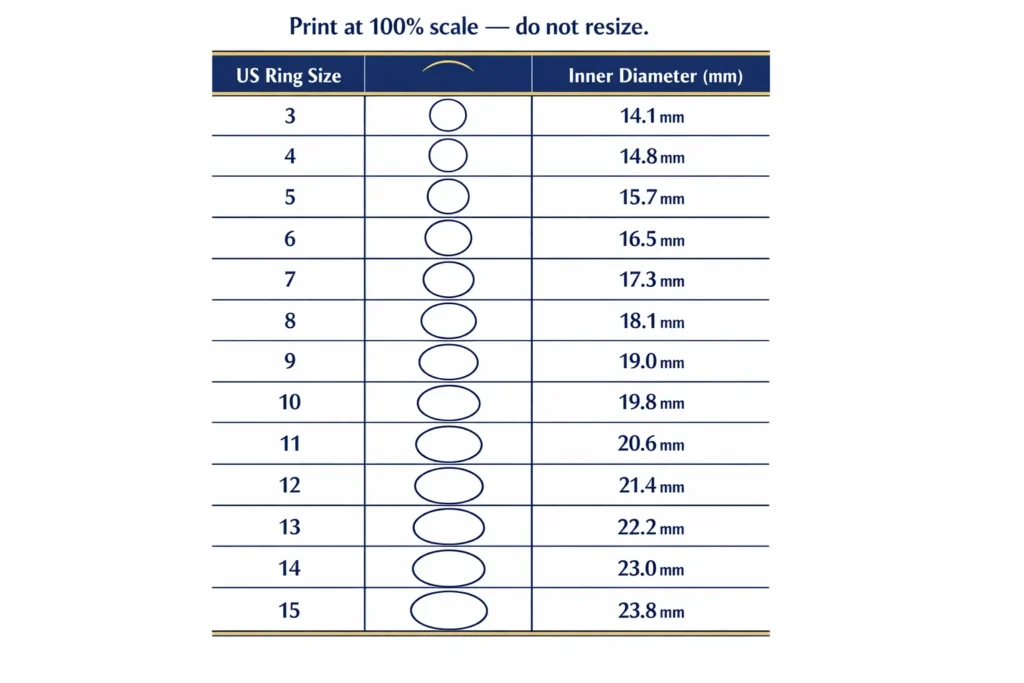
A ring sizer tool typically costs no more than a few dollars, and they can be found online, at craft stores, or in major retailers. Many simply include a larger ring, draped with smaller rings in various sizes to try on (à la a ring of keys). Others are more compact, built like a circular tape measure that’s adjustable around a finger.
Measuring With a String or Paper
One of the easiest ways to take your ring size is by using a string or a strip of paper. Simply wrap your string or paper around your finger and mark it with a marker or by tying a knot to indicate your finger’s circumference. Then, measure the string or paper in millimeters with a ruler or tape measure.
You can then find your corresponding ring size online or use a printable ring sizer chart.
Measuring With Existing Rings
Another simple way to determine an accurate ring size is by using a ring you already own that fits you comfortably. This method is also great if you’re looking to find out your partner’s ring size without their knowing. Find a printable ring size chart. To ensure it’s to scale, choose “Scale 100” when printing. Then, find the circle that most closely matches the size of your existing ring.
Tips for Ensuring Accuracy
Ring sizing is not an exact science, so it’s essential to account for any potential errors before making your purchase. That said, the following guidelines will help ensure precision:
- Measure multiple times– Measure your finger multiple times (and perhaps using multiple methods) to confirm the correct size. Remember, even one or two millimeters difference could change your result.
- Measure at different times of day – As humans, our size fluctuates throughout the day, influenced by fluid retention, our diets, temperature, and even compression from gravity (which is why we wake up slightly taller). In general, your fingers will be at their largest in the evening, but sometimes, conditions like arthritis (or even sleeping in the “wrong” position) can cause morning swelling, so be sure to take measurements at multiple times of the day and denote an average measurement to find the right size.
Common Mistakes to Avoid
When measuring ring size at home, it’s easy to make mistakes that can lead to an inaccurate fit. These errors can affect the comfort and appearance of your ring, making it essential to be aware of common pitfalls.
In general, you’ll want to avoid:
- Printing the wrong size chart – To ensure an accurate ring size reading, you’ll need an accurately sized ring sizer chart. Don’t forget to set that print scale to 100.
- Measuring the wrong finger – To get an accurate measurement, be sure to measure the exact finger you plan to wear the ring on. Your ring finger as opposed to your pointer finger can vary by half to a whole size, and the fingers on your dominant hand are likely a half-size larger than their corresponding finger on your non-dominant hand.
- Neglecting knuckle size – When measuring your ring size, it’s crucial not to overlook the size of your knuckles. Many people forget that the ring needs to comfortably slide over the knuckle, which can be significantly wider than the base of the finger, depending on your finger shape. To ensure a proper fit, measure both the base of your finger and your knuckle. If there’s a significant difference, consider choosing a slightly larger size or a ring with an adjustable band.
- Forgetting to consider the weather– When measuring your ring size, it’s important to take into account the effect of weather on your fingers. Our bodies, including our fingers, naturally expand in warmer temperatures and contract in colder weather. This fluctuation can significantly impact the fit of a ring. To avoid any fluctuations, try to measure your ring size at a time when your body is at a comfortable, average temperature.